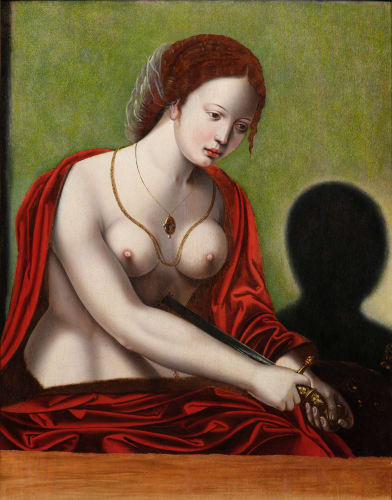
Lucretia/ Lucrèce
This painting depicting the suicide of Lucretia intrigues us with its strangeness. Although inspired by the artworks of the Master of Female Half-Lengths, it differs from them in its great sensuality and violent lighting. It is certainly the work of a different painter, also Flemish but probably later. The quality of the underlying drawing and the numerous pentimenti visible in the infrared reflectography indicate that this is indeed an original work by an anonymous painter, whom we propose to designate as the Follower of the Master of Female Half-Lengths.
- Description of the painting
This painting depicts the tragic moment when Lucretia, the wife of Lucius Tarquinius Collatinus (Tarquin Collatin), commits suicide in front of her father and husband to clear her honor after being raped by her husband's cousin (Sextus Tarquin, the youngest son of the King of Rome, Tarquin the Proud).
The young woman's fixed gaze and half-closed eyes evoke both her determination and the numbness that is beginning to overwhelm her as the dagger, already deeply embedded in her solar plexus, is pursuing its deadly path. The few drops of blood visible under her arm foreshadow the hemorrhage that is about to kill her. This hemorrhage is perhaps also metaphorically foreshadowed by the folds of the scarlet cape lined with fur that she has just taken off.
The details of her adornments are finely represented: a gauze veil encircles her hair, a supple gold chain adorns her chest and hugs the contours of her breasts, emphasizing them; a second chain closer to her neck holds an oval pendant adorned with pearls.
The infrared reflectography we had carried out reveals an underlying drawing of great firmness, which establishes most of the anatomical elements with great precision (the drawing of the phalanges is a good example) but also shows numerous pentimenti, mainly in the positioning of the chest and the two gold chains.
2. An original artist: the Follower of the Master of Female Half-Lengths
The theme of Lucretia was one that was dealt with extensively by the Master of Female Half-Lengths, as can be seen in the two paintings reproduced below. One was sold at Christie's on September 15, 2020 (lot 14), while the other one appeared at Duran on June 25, 2020, before being acquired by the De Jonckheere gallery.
The Master of Female Half-Figures is an anonymous artist who was named by the art historian Max Jacob Friedländer after a painting in the Harrach collection in Schloss Rohrau, Austria, which depicts three young women singing and playing musical instruments in an interior[1]. The paintings traditionally attributed to this master, one of the most successful and popular Flemish artists of the second quarter of the 16th century, are now considered to be the product of a workshop active in Antwerp (or Mechelen), specializing in half-length portraits of elegantly dressed young women who are depicted reading, writing, or playing music in intimate domestic settings. These paintings, generally small, were painted in a courtly style like that of Bruges painters such as Adriaen Isenbrandt (c. 1485-1551) and Ambrosius Benson (late 15th century-before 1550).
While the influence of the Master of Female Half-Length is notable, our painting is characterized by an aggressive eroticization of Lucretia's body and a dramatization of the lighting. As demonstrated by infrared reflectography of the work, this panel has been painted by an original artist with great drawing ability, whom we propose to designate as the Follower of the Master of Female Half Lengths.
Significantly larger than the two Lucretia reproduced above, our painting stands out for Lucretia's much rounder breasts and the highly geometric aspect of the overall composition, which is treated in ovals and curves (note the chain holding the pendant, which is placed in line with the hair under the gauze).
We are also struck when looking at this painting by the presence of the shadow cast on the left of Lucretia and by the shadow lines on the left and at the top of the painting. These shadows evoke a harsh, almost cinematic lighting, while creating an effect of depth. Although this same technique is found in several paintings by the Master of Female Half Lengths or his circle, the lighting here is much harsher and the delineation of the cast shadow is abrupt. We illustrate this difference with two works featured in the RKD database: a Virgin and Child attributed to the Master and a Saint Mary Magdalene Writing.
It is interesting to note that the pompom on the cushion on which Saint Mary Magdalene is seated is very similar to the one that appears in the lower right corner of our Lucretia.
3. Framing
Our painting had been thinned (before the stamp was affixed and therefore probably in the first third of the 19th century) and fixed to a wooden backing which was removed to allow the panel to regain its natural curvature. The joints between the different planks that make up the panel were reinforced where necessary with small wooden pegs.
We chose to frame this painting with a 17th-century Italian frame made of painted and gilded wood, reminiscent of Flemish frames from the same period.
[1] M.J. Friedländer, Early Netherlandish Painting, vol. XII, Leiden 1975, p. 100, no. 106, reproduced pl. 45; https://rkd.nl/images/31629